The Amazon of the Planalto
“The Women Warriors of the Amazon are fascinating people who cut their right breasts off. They would go to any extent to achieve victory. Are the Amazonian women real or are they the figment of someone’s imagination?”
Anish Chandy(1)
Some people think that the Amazon region of Brazil was the original playground of the famed women warriors, the Amazons. Actually, it is the other way round: the geographic name Amazon derives from that of the mythical Greek warriors. Legend has it that the 16th century Spanish conquistador Francisco de Orellana coined the name Amazon. Apparently during one of his expeditions, he was nearly defeated by the Icamiabas Indians. This tribe was famous because its men and women fought alongside each other. Other historians speculate that since the Indians were wearing grass skirts, Orellana who knew his Greek mythology mistook them for women warriors. On this issue, the jury is still out.
Literature describes the Amazons as resembling the Roman goddess Juno’s. Juno’s athletic body was covered with a goatskin like that of the soldiers. Amazons were murderous warriors which fought on the battlefields in Ancient Greece, Asia and Africa. Their society was matriarchal to the extreme of murdering their male offspring since they were of limited value. Adult males were confined to reproduction duties (the future generation of girl warriors) and to emasculating slavery (doing traditional women’s chores).
Since bows and arrows are no longer used, modern day’s Amazons don’t need to remove their right breasts. Nowadays, gym and political spheres are the battlefields of modern Amazons. In the pumping iron clubs, the term “modern Amazons” refers to steroids-popping muscular body building women. On the other hand, political Amazons may not display well-toned bodies but they have a far more impressive resumé. They fight for political offices and are regarded by some as women doing a man’s job.
In Portuguese planalto means plateau. The office of the president of Brazil is called the Planalto, which is derived from the plateau where it is built. Luiz Inácio Lula da Silva, known across the world as Lula is the current resident; he will step down at the end of the year. Lula has been actively grooming and forcefully promoting his female chief-of-staff Dilma Rousseff. Dilma qualifies as a modern day political Amazon. In Brazil, she goes by her first name.
During the 20th century only three women Golda Meir, Indira Gandhi and Margaret Thatcher, left their marks in world politics. These so-called iron ladies graduated into true Amazons when faced with the prospect of war. Not only did they courageously lead their countries through the conflicts but they took very belligerent position to win the wars. Notably in 1982, Maggie Thatcher defeated the Argentine dictators who had landed troops on the British Falkland Islands. No doubt that this female intrusion into a territory regarded as a male preserve was resented by a number of big guys. Indira Gandhi was nick named Clever Fox by US President Richard Nixon who tremendously disliked her.
Latin America is legendary for being a hotbed of machismo. However the region has had probably more women presidents than the more gender-equalitarian North America and Europe. In Latin America, female politicians traditionally get their positions thanks to the patronage of husbands or fathers. Actually the strong politicos latinos mastered the art of political durability by substituting their wives, mistresses, daughters and sisters as proxies in political offices. Argentina, Panama, Honduras and Guyana have all elected their late presidents’ widows with the backing of the party and the family clan.
In 2007, Argentina elected its second woman president Cristina Fernandez de Kirchner, the embodiment of the modern proxy wife. She is the wife of Néstor Kirchner the former president. Because Néstor Kirchner feared to see his popularity eroding during a second term he decided not to run again. Instead, he had his wife elected to the presidential office. The shift from Néstor to Cristina is only cosmetic, literally as Cristina makes unrestrained use of Botox, heavy make-up and black mascara. Argentina’s neighbors, the burly Falkland Islanders affectionately refer to her as “old plastic face!” Machismo crosses cultural borders!

Cristina Fernandez de Kirchner
Because the first female president, Juan Peron’s widow Isabelita, was a total disaster the Argentines may be less inclined to condone mediocrity at the top. Cristina has therefore a hard time convincing her fellow Argentines that a women’s place is in the Casa Rosada, the Pink House as the presidential palace is known. In 2010, life is not rosy for the Kirchner couple. Cristina is not longer popular and as a result the Kirchner brand is losing its appeal. Néstor’s candidacy to the 2011 presidential elections is now in doubt.
In Chile, on the other hand, Michelle Bachelet was elected president on her own merit (2). Barred by the constitution from running for a second term, Michelle Bachelet left office with an approval rating of 84% in the wake of the disastrous earthquake. Her strong points were sound economic decisions, realistic social policies and empathy. To the patriarchal Chilean society she has demonstrated that women can be efficient presidents. Bachelet’s social policies as well as her no-nonsense appearance endeared her to the female electoral.
With only a 30% approval rating, Cristina counts few women in her fan club. The two presidents could not be more different, just like their respective countries. Chile comes across as lackluster and somewhat stodgy, whereas Argentina conveys flamboyance with a touch of insubstantiality. Chile could compare to the ant of La Fontaine’s fable and Argentina to the grasshopper.
.
In the patriarchal Latin American societies, women usually resent powerful women who step out of the traditional female role. Women are viscerally critical and jealous of other women’s achievements. They dislike aggressive and competitive attitudes regarded as male attributes; coincidentally, these are the basic requirements to get into politics. This mind-set doesn’t help the career of would-be women politicians. Sadly, this way of thinking is not restricted to Latin America. During the 2008 presidential election campaign in the United States, Hillary Clinton was blamed for “reinforcing the Genghis Khan principle of American politics that our leaders must be ruthless, macho and opportunistic” (Susan J. Douglas 3). Are Amazons not Genghis Khans in skirts?
At that time, pollsters were hard at work assessing Clinton’s negatives. All the same, Brazilian pollsters are now dissecting Dilma Rousseff’s own negatives. Not surprisingly her negatives are carbon copy of men’s “positives”!
Everyone acknowledges that Dilma is a self-made politician. However she is resented because of the fact that she is shamelessly propped up by Lula. Sadly, if elected, she will join the ranks of proxy woman presidents. Rumor has it that Lula plans to come back when her first term is over. Lula’s popularity is said to be around 80% and he is
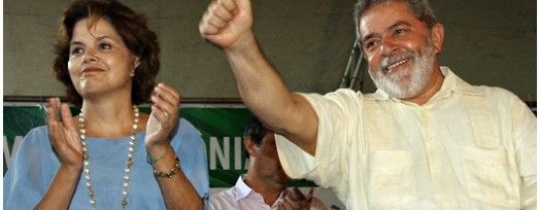
The winning couple: Dilma and Lula. Photo from Dilma’s blog. 2010.
trying to transfer some of it to Dilma. The president is playing Pygmalion to transform an ugly duckling into a winning candidate. A tall order! Dilma’s own campaigning skills haven’t blossomed yet. On the pre-campaign trail (official campaigning hasn’t started yet), she comes across as uncharismatic, rude, uncaring and either bored or impatient. She is said to be a bit of a bully and lacks feminine empathy.
It is not uncommon to brand powerful women as a bully. In Dilma’s case, this attribute goes with the territory. In the late 60s, during the military dictatorship, the police filed her as a leftist terrorist. She was jailed for robbing banks and carrying weapons. She was eventually tortured, a common practice in those days. These facts are not included in her official résumé and may not be entirely true. As a result the comfort level of middle class voters is low. This will probably not hinder her election thanks to the votes of the poor masses that have benefited from the generous cash transfers of the Lula’s government. Thanks to these hand-outs, Lula has built a loyal base which will vote for whoever he recommends. Since voting is compulsory in Brazil, Dilma has a good chance to become President Dilma, the Amazon of the Planalto.
Beatrice Labonne. March 20, 2010.
1) www.buzzle.com 2004
2) Laura Chinchilla, the former vice president was recently elected president of Costa Rica
3) Professor of Communications Studies. University of Michigan at Ann Arbor, USA
|




 URL site map
